
#1. Please share with us 5 things you did that helped you grow & become the professional you are today
#2. What challenges will the participants find solutions to during your session at I T.A.K.E Unconference 2017?
#3. Recommend for the participants 3 sources you find inspiration from and would help them better understand you
I play GO (or wieki) – an ancient Chinese strategy game – unfortunately less often, I enjoy reading Fantasy and Sci-Fi literature, but one of the books I enjoyed reading is a military treaty – Sun Tzu’s Art of War, and one of my favorite authors is Mario Vargas Llosa, from a professional perspective Patrick Lencioni – The Advantage was an inspiration. And to conclude – the best source of information is the team you work with, they will show you what you need to learn so you can work together.
Want to join Liviu and ~300 software crafters from around Europe?
Register now for I T.A.K.E Unconference 2017!
Node.JS OSS
#1. Share with us 5 things you did that helped you grow & become the professional you are today
- I got the chance to work with technology from a very early age (think ZX Spectrum, Intel 8088) and also with assembly language. This taught me to appreciate constraints and never ignore optimization or be lazy.
- Discovering OSS via the Allegro game library lead me to a wealth of code to analyze and learn from.
- Getting a job in the IT department at the university while being a student there leading to four years of experimenting with whatever I wanted to.
- Teaching at the same university.
- Getting involved in the Drupal community, taking part in the creation of Romanian branch, organizing various camps and teaching Drupal.
#2. What challenges will the participants find solutions to during your session at I T.A.K.E Unconference 2016?
#3. What else would you like to share with participants
- I am a very bad theremin player. The theremin was the first electronic instrument ever invented and you play it by not touching it. Check it out, it’s pretty cool.
- I am passionate about synthesizers, old hardware and horror movies.
- I am an amateur musician using Gameboys, Commodore 64 sound chips and other retro things. I once played music in the Gara de Nord railway, at the info panel.
- I like to ride statues (usually of pigs) while pretending to be Bastian from the Neverending Story.

Want to join Alexandru and many more software crafters from around Europe?
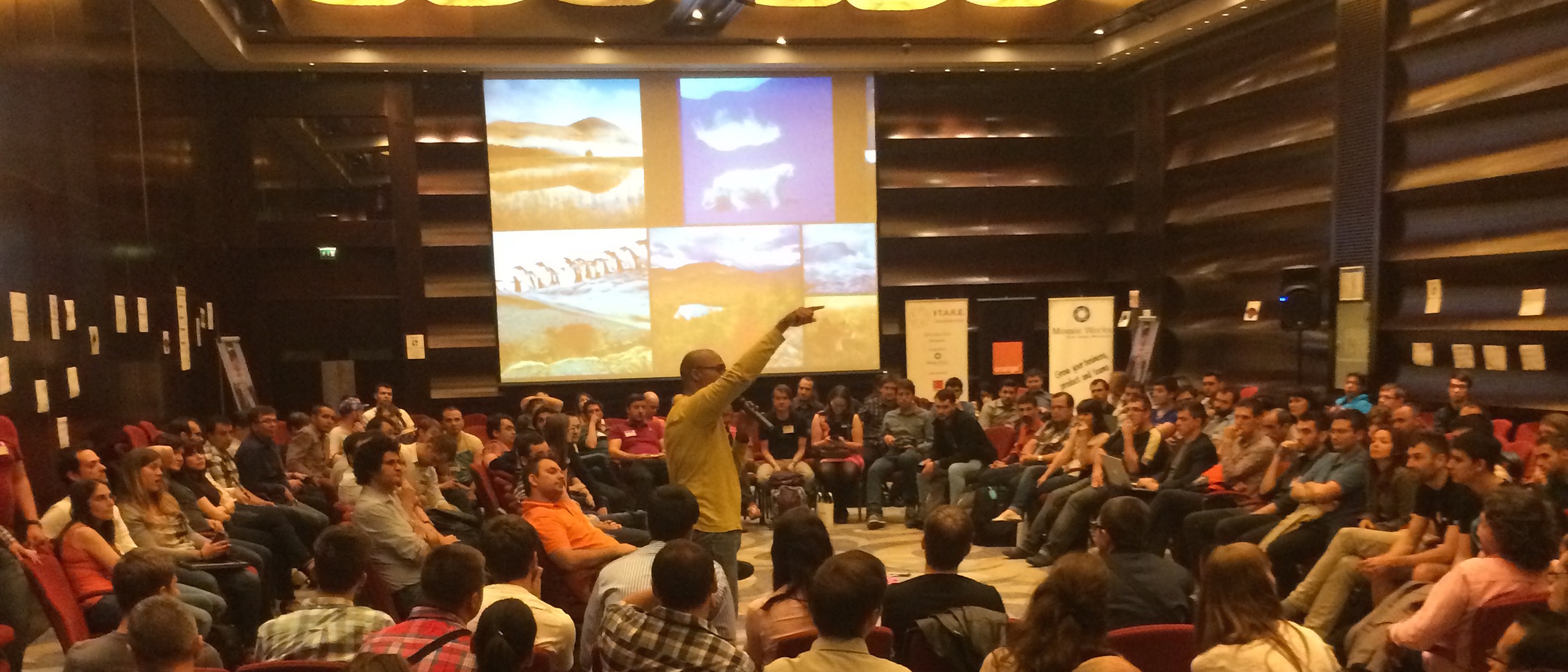
I T.A.K.E. Unconference Day 1 – Slides & Videos
An unconference is as special as its participants. Thank you everyone – Speakers, Facilitators, Bumblebees & Butterflies for working all together, writing code, pairing, solving problems while discussing, listening and sharing knowledge.
After such an awesome gathering of practitioners, we are happy to share the presented slides.
Structured by tracks, find them all below.
I T.A.K.E. Unconference Day 1 – Slides & Videos
Keynote
 Simon Brown: Software Architecture as Code
Hardcore Programming
 Stefan Kanev: Clojure, ClojureScript and Why They’re Awesome
 Ionut G. Stan: Let’s write a type checker + Code
Quality Practices
 Igor Popov: Mutation Testing
 Svetlana Mukhina: Metrics that bring value
 Patroklos Papapetrou: Holding Down Your Technical Debt with SonarQube
Executable Specifications
 Cyrille Martraire: Living Documentation Jumpstart
Developer’s Life
 Andrew Hall: Power Up: Learn How to Recharge Your Energy Bar
 Krasimir Tsonev: 7 Rules to Get the Things Done
 Thomas Sundberg: The responsible Developer
Architecture
 Tim Perry: Microservices and Web Components Are The Same Thing

 Robert Mircea & Virgil Chereches: Our Journey to Continuous Delivery
DevOps
 Andrei Petcu: Rocket vs Docker: Battle for the Linux Container
 Alex Bolboacă: Why you should start using Docker?
See also: Day 2 Slides & Videos
We hope to see you again at the next I T.A.K.E. Unconference edition.
The recorded videos are now being processed. Stay tuned.

Programming contest @I T.A.K.E Unconference
As for every I TAKE Unconference edition, we want to give a chance to the software crafters from the audience to showcase their skills and learn more in the process. And because we appreciate passion, we offer a prize to those who convince a jury of well-known international developers that they are the most skilled in the room.
This contest is not meant to be easy. It will require you to practice beforehand, so please read the instructions carefully.
It will also require you to register before the event.
Mechanics
- IMPORTANT: Register to the contest latest one day before I TAKE Unconference by sending an email to steliana.moraru@mozaicworks.com
- On the first day of the event, after lunch, you have max 15′ to do a performing kata in front of the jury.
- The winner will be announced at the end of the second day
Constraints
To simplify the jury’s decision, the performing kata has to conform to the following constraints:
- Only the following programming languages are accepted: Java, C, C++, C#, Python, Visual Basic .NET, PHP, Javascript, Swift or Ruby
- Only solo contestants are accepted. Sorry, no pair programming this time
- The kata has to showcase refactoring skills.
- The kata has to last max. 15′
How we will judge
The jury will judge your refactoring skills.
The ideal kata looks like this – you will get maximum point if you:
- clearly state the smells you see in the code
- pick one of the smells
- clearly state your plan to fix the smell
- fix it in small, safe steps
- run tests after each step to prove you didn’t break anything
- commit after each step with a clear message explaining why you made the change
- fix as many smells as possible within the time constraint
You will loose points if you:
- make big or unsafe changes to the code
- break the behaviour after changing the code
- don’t improve the code a lot
- don’t improve the design by the end of the kata (hint: we judge design using SOLID principles and the four elements of simple design)
Recommendations
To help you, we’ve thought out what we would do if we participated to such a contest. Here’s what we recommend.
1) Use one of the following codebases for the kata:
- https://github.com/emilybache/GildedRose-Refactoring-Kata
- https://github.com/emilybache/Tennis-Refactoring-Kata
- https://github.com/emilybache/Yatzy-Refactoring-Kata
- https://github.com/emilybache/Parrot-Refactoring-Kata
2) Practice beforehand on the structure we presented for the ideal kata. Ideally find someone to practice with.
3) Watch other people refactoring. YouTube has many videos on the topic, including using the recommended code bases.
Glossary
A programming kata is a repeatable exercise used to practice specific skills.
Performing kata means doing a kata in front of an audience.
Refactoring means changing the internal structure of the code without changing its behaviour.